
SWANA Land of Lincoln Newsletter - Winter 2025 
President's Report
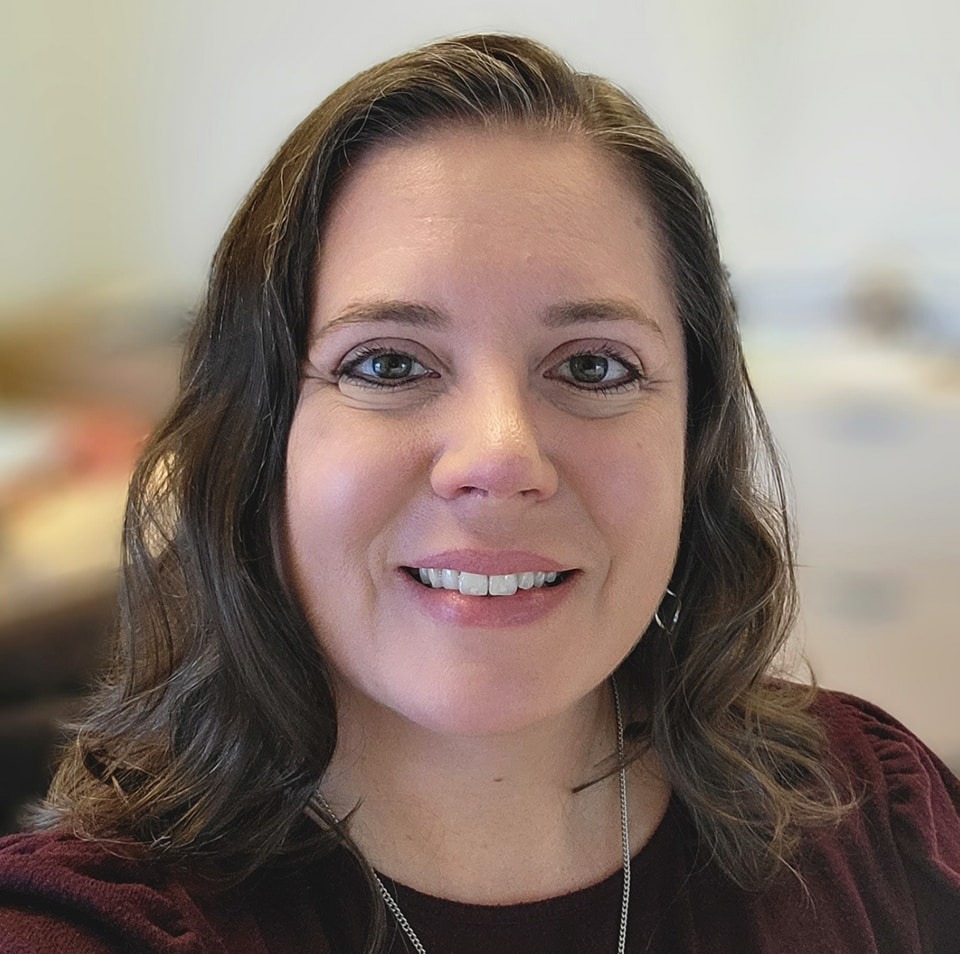
As we close out 2025, it’s a great time to reflect on what has been a standout year for the SWANA Illinois Chapter. This year brought many new and strengthened levels of engagement with all of you, including:
- Launching a refreshed Chapter website
- Expanding MOLO training opportunities to meet the needs of state-licensed landfill operators
- Hosting the Illinois Circularity Conference in partnership with the Illinois Counties Solid Waste Management Association (ILCSWMA) and Illinois Recycling Foundation (IRF), bringing together more than 150 attendees from across our industry and state
- Growing our Young Professionals network, with consistent, energized participation by more than 25 YPs in monthly meetings, periodic hosted events, and now in expansion of our historically Board-level committee structure. We also appointed a YP Co-Liaison, Max Ehret (Republic Services)
Our successes this year are a direct result of your involvement, and for that I say THANK YOU. As we look ahead to 2026, I encourage all of you to stay active, lend us your voice and ideas, and help us continue building momentum. We’re especially excited about growing our committee roles and offering a variety of knowledge-sharing and networking events in the year ahead, creating even more ways for you to connect. I’m proud of what we’ve built together and excited for what we’ll accomplish next.
Have an idea for an event, way to engage, or want to get more involved? Reach out to [email protected] or [email protected].
Cheers to our successes in 2025 and to continued growth in 2026!
Christina Seibert
SWANA Illinois (Land of Lincoln) Chapter President
Calendar of Events
SWANA YPs Virtual Meeting - Dec. 30, 2025, 1:30pm
email [email protected] for info and meeting link
Editor's Note
The Land of Lincoln Chapter is grateful to feature writing from our Young Professionals group in this newsletter. Check the by-lines to see who's involved and email [email protected] with feedback or to contribute.
Safety Moment
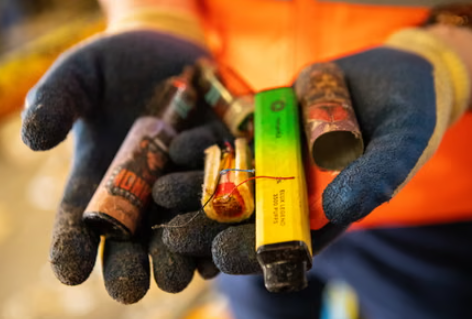
Vapes, Batteries, and Better Solutions
Emily Wachter, Solid Waste Agency of Lake County
As electronic cigarette and vape usage rise in the United States, so does concern about safely disposing of these hazardous items. Improper handling of e-cigarettes can harm the environment and create dangerous conditions at waste and recycling facilities. With more states exploring extended producer responsibility (EPR) policies to manage these products, proper disposal is becoming a growing part of the conversation.
In 2019, 4.5% of adults in the United States used e-cigarettes. As of 2024, that percentage has risen to 6.5%, meaning roughly 17 million adults in the United States use e-cigarettes. These devices contain both nicotine and lithium batteries. When disposed of improperly, nicotine can pollute soil and waterways. If lithium batteries are disposed of in household recycling or trash bins, they can get damaged and cause fires at waste and recycling facilities, injuring workers and damaging equipment.
In Illinois, e-cigarettes should be taken to a household hazardous waste (HHW) collection event or facility for proper disposal. Due to the cost and safety concerns associated with handling e-cigarettes, lithium batteries, and other hazardous waste, many states are turning to EPR laws to shift disposal costs and responsibilities back to manufacturers.
Nebraska’s “Safe Battery Collection and Recycling Act” (LB36) establishes an EPR program for batteries; however, this law does not cover e-cigarettes. Nebraska does separately regulate the sale of e-cigarettes (LB1296).
California has taken a more aggressive approach, with dozens of jurisdictions completely banning the sale of e-cigarettes. The state currently has EPR programs for certain types of HHW, and proposed legislation (SB501) would expand coverage to explicitly include e-cigarettes.
Vermont’s “Household Hazardous Products Stewardship Law,” expected to launch in the new year, includes e-cigarettes in its list of covered products.
EPR policies have focused solely on nicotine e-cigarettes—cannabis vapes are not included. This gap in coverage is why a new Missouri-based pilot program is drawing attention.
A Closer Look at Missouri’s New Cannabis Vape Take-Back Program
The Heights Dispensary in Maryland Heights, Missouri, is one of the first dispensaries to install a take-back kiosk for cannabis vapes. A partnership between Monarch Waste Co. and CÚRADOR, a cannabis brand, is covering the costs and leading the program. The Heights Dispensary customers can drop off their used cannabis vapes during their routine shopping trips—a time when many customers have spent vapes on hand as they come in to buy replacements.
According to the Heights Dispensary team, the biggest challenge has been awareness. Many customers do not realize cannabis vapes contain lithium batteries that require special handling. Once customers learn of the drop-off kiosk, participation becomes habitual, much like recycling any other household product. The convenience of having the take-back program at the point of purchase has been a key to the program’s success.
As e-cigarette and vape use—nicotine and cannabis alike—increase nationwide, states and local programs are working to keep hazardous materials out of landfills and recycling streams. Missouri’s pilot program demonstrates how accessible, producer-supported take-back programs can help manage these hazardous materials responsibly.
Get Social

The SWANA Land of Lincoln Chapter has a new LinkedIn page! Please follow us here. We are happy to cross-post any open positions in materials management and closely related fields.
News: Statewide

New PaintCare Program Now Active in Illinois
Myles Barnes, DuPage County Facilities Management
The PaintCare paint recycling program officially launched across Illinois on December 1, 2025, providing households and businesses with a year-round, statewide solution for recycling leftover paint, stain, and varnish. Operated by PaintCare, a nonprofit organization formed by paint manufacturers under the American Coatings Association, this program establishes a network of over 250 convenient drop-off sites at paint and hardware retail locations as well as local government facilities where latex and oil-based paints, primers, stains, sealers, and varnishes can be dropped off at no charge. The initiative is funded by a small PaintCare fee added to the sale of new paint products and is implemented under the Illinois Paint Stewardship Law, with oversight from the Illinois EPA.
PaintCare represents an important expansion of sustainable materials management and product stewardship in Illinois. Leftover paint has long posed challenges for solid waste and recycling systems, often ending up in landfills or being managed through costly household hazardous waste (HHW) programs. This statewide program reduces the burden on municipal solid waste infrastructure by diverting paint into reuse and recycling streams, supports landfill diversion goals, and encourages collaborative partnerships between local governments, retailers, and waste service providers. By offering free, convenient drop-off options and reducing illegal or improper disposal, PaintCare strengthens community recycling capacity and aligns with environmentally and economically sound waste management practices valued by local officials, consultants, facility operators, and haulers throughout the region.

Spread the Word: Support Climate Literacy in Illinois
Myles Barnes, DuPage County Facilities Management
The Illinois Climate Education Hub is a newly launched free online resource designed to support Illinois K-12 educators in teaching climate change and climate solutions across all subjects and grade levels. Developed in partnership with Climate Education for Illinois, Subject to Climate, and other education organizations, the Hub provides vetted, standards-aligned lesson plans, professional development, and Illinois-specific climate content to help schools comply with newly enacted state climate education requirements taking effect in the 2026-27 academic year.
How SWANA members can support and leverage this initiative:
- Share the resource with local schools and sustainability partners. Many school districts are preparing for the new climate education mandate and may welcome access to quality, free materials.
- Connect your organization with educators. Offer to host student tours of facilities, guest lectures, or real-world projects that link climate impacts to solid waste systems.
- Highlight climate-waste intersections in outreach. Use Hub materials or community presentations to illustrate how waste management practices influence greenhouse gas emissions and local environmental outcomes.
- Partner on community education initiatives. Collaborations with schools can foster climate literacy among future professionals and residents, strengthening support for sustainable waste and infrastructure practices.
Visit the Illinois Climate Education Hub, explore its free materials, and share the link with educators and partners in your community to help expand climate literacy across Illinois.
Policy to watch: SB1397 & SB1398/HB1707
Emily Wachter, Solid Waste Agency of Lake County
The impact of food waste is significant for people who are food insecure and for the environment. According to Feeding America, 1 in 8 Illinoisans are food insecure. ReFED reported that Illinois generated nearly $13.8 billion worth of surplus food in 2023. Uneaten food is overwhelmingly landfilled. Food scraps make up 24% of landfill waste and generate 58% of landfill methane emissions. Methane is 80 times more potent than carbon dioxide in driving climate change over a 20-year period. To address these concerns, Senator Adriane Johnson and Representative Joyce Mason filed SB1397 and SB1398/HB1707, which aim to:
- Reduce methane emissions by diverting food scraps from landfills
- Increase food recovery for human consumption
- Provide data on the benefits of compost and digestate use on agricultural land
- Phase in food diversion requirements to provide time for infrastructure to develop
Since the end of the 2025 legislative session, primary bill sponsor Senator Johnson and her staff have held multiple meetings with SB1398’s key stakeholders, organized under the name "Feed and Conserve Illinois," with the goal of drafting bill amendments. The sponsors, co-sponsors, and supporters of SB1397 and SB1398/HB1707 recognize that meaningful change takes time, collaboration, and persistence, and are committed to building support in the years ahead. SWANA members are encouraged to visit https://www.feedandconserveil.org/ and subscribe to the email directory to learn more. Specific questions or resource requests can be directed to: [email protected].
News: Northeast Illinois
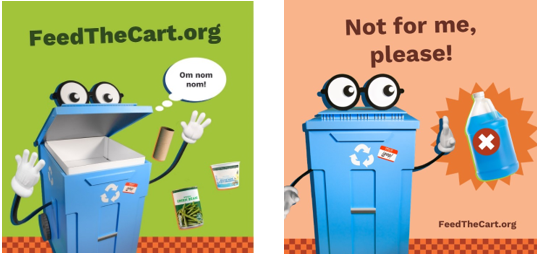
Feed the Cart
Johanna Strohschein, Will County Land Use Department
Feed the Cart is the largest coordinated outreach and education campaign focused solely on recycling in Illinois history. It launched this past fall, championed by dedicated staff from public agencies across Northeastern Illinois. Funded by the US Environmental Protection Agency (EPA), the Recycling Education and Outreach (REO) Grant was awarded to the Metropolitan Mayor’s Caucus and a partnership of six local entities who, with the help of a skilled marketing company, are the architects of the project. The funded local partners are DuPage County, Kane County, McHenry County, Will County, the Solid Waste Agency of Lake County, and the Solid Waste Agency of Northern Cook County. As the project has developed, the partners are also grateful for participation from the City of Chicago, Cook County Government, and Recycle Coach. Thank you for working hard to make recycling easy!
The dual focuses of the campaign are to increase the rate of recycling in the Chicago metro area and to reduce contamination. Recycling contamination is a common occurrence which negatively impacts material processing and public perception of the industry. Attempting to recycle things like batteries and plastic bags at the curb, can cause detrimental fires and equipment failures behind the scenes. This education campaign aims to minimize contamination and foster confident participation in recycling. Impact will be measured through efforts by SCS Engineers (several on staff are SWANA IL members), which will work with municipalities, waste haulers and MRFs to capture pre- and post-campaign data.
The project website, FeedTheCart.org makes recycling simple, easy, and fun! Meet Loop, a little cart with a big appetite. Not sure if something can be recycled? Loop is here to help! The campaign and website integrate Recycle Coach, the web tool and app full of local recycling information that is now available to all Illinois communities at no direct cost.
- Visit feedthecart.org and cross to the Waste and Recycling Info search tool by Recycle Coach
- Select a town, village, County or City (NE IL only)
- Use the What Goes Where tab to search all manner of recyclable and non-recyclable items to get the best options
FeedTheCart.org is easy to navigate. It highlights the benefits of recycling, reuse, and composting while addressing common questions about waste disposal. Learn about the Dos and Don’ts of curbside recycling. Discover local collection events for odd-ball items like batteries, electronics, Styrofoam, and scrap metal. Make Loop happy by keeping your recycling bin free of contaminants!
